Building Trustworthy Engineering Practices for AI-Generated Code
Fri, 02 Oct 2026
Follow the stories of academics and their research expeditions
Augmenting Academic Excellence Through Intelligent Automation
Faculty members in engineering colleges spend significant time on activities beyond classroom teaching—preparing courses, creating assessments, reviewing research, maintaining documentation, and managing repetitive academic workflows. Generative AI and Large Language Models (LLMs) can help reduce this workload while allowing faculty to focus more on teaching, mentoring, research, and innovation.
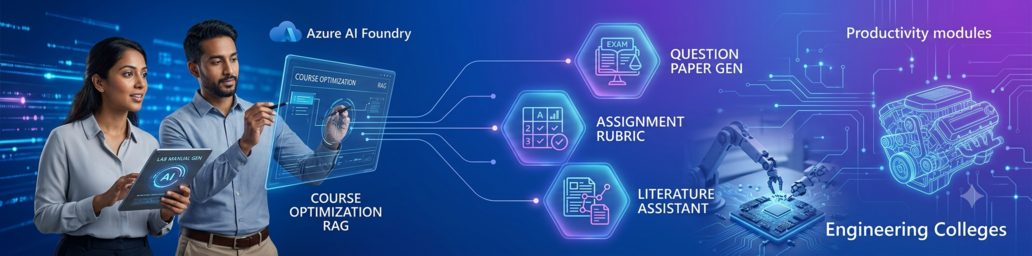
Using Microsoft Azure AI Foundry, these capabilities can be developed as practical, institution-specific AI applications rather than relying only on general-purpose chatbots.
Preparing lectures, notes, presentations, examples, and learning activities can be time-consuming. An AI-powered Course Preparation assistant can generate structured teaching content based on the syllabus, course outcomes, prescribed textbooks, and faculty-provided material.
Faculty can use it to create lecture outlines, explanations at different difficulty levels, real-world examples, discussion questions, and revision material—while retaining control over the final content.
Creating balanced question papers requires considerable effort and careful alignment with the syllabus and learning objectives. AI can generate questions based on specified units, topics, marks, difficulty levels, and cognitive levels.
The system can also help create multiple versions of a paper, map questions to course outcomes, and maintain appropriate coverage across the syllabus.
Faculty can provide a topic, learning outcomes, and expected student level, and the AI can generate assignment ideas along with evaluation rubrics.
This can make assignments more outcome-oriented and provide faculty with consistent criteria for evaluating student work. Rubrics can include measurable parameters such as technical understanding, implementation, analysis, documentation, and presentation.
Important faculty knowledge is often distributed across PDFs, lecture notes, regulations, curriculum documents, lab resources, and institutional guidelines.
A Retrieval-Augmented Generation (RAG) application can make these resources searchable through natural-language questions. Instead of searching through multiple documents manually, faculty can ask questions and receive answers grounded in the institution's approved knowledge sources.
Research activities involve continuously discovering, understanding, comparing, and organizing technical literature. An AI research assistant can help faculty summarize papers, extract key findings, compare methodologies, identify research themes, and organize literature around a specific topic.
This does not replace scholarly judgment; rather, it reduces the time spent on repetitive literature-analysis tasks.
Developing and updating laboratory manuals requires both technical accuracy and consistent formatting. AI can assist faculty in creating experiment objectives, prerequisites, theoretical background, procedures, expected outcomes, viva questions, troubleshooting guidance, and assessment criteria.
Faculty can then review and refine the generated material according to their laboratory setup and curriculum.
Engineering colleges generate a large volume of academic and administrative documentation. An AI documentation assistant can help prepare course files, meeting notes, activity reports, academic summaries, project documentation, and other structured documents from faculty-provided information.
This can significantly reduce repetitive writing and formatting work.
The next step beyond content generation is AI-powered workflow automation. An AI agent can coordinate multiple steps in a faculty workflow—for example, taking a course syllabus, preparing a draft course plan, generating learning outcomes, suggesting assessments, creating a question bank, and producing supporting documentation.
With appropriate permissions and human approval, agents can transform AI from a question-and-answer tool into an assistant that actively supports recurring academic processes.
From AI Tools to AI-Powered Faculty Productivity
The objective is not to replace faculty expertise. It is to augment it.
Azure AI Foundry provides a platform for building these use cases with institution-specific data, RAG capabilities, AI models, agents, and application workflows. The result can be a collection of purpose-built AI assistants designed around the actual responsibilities of engineering faculty.
When implemented responsibly—with human review, data security, access control, and appropriate governance—these solutions can reduce repetitive work, improve consistency, and give faculty more time for what matters most: teaching, mentoring, research, and innovation.
Fri, 02 Oct 2026
Leave a comment