Inspirational journeys
Follow the stories of academics and their research expeditions
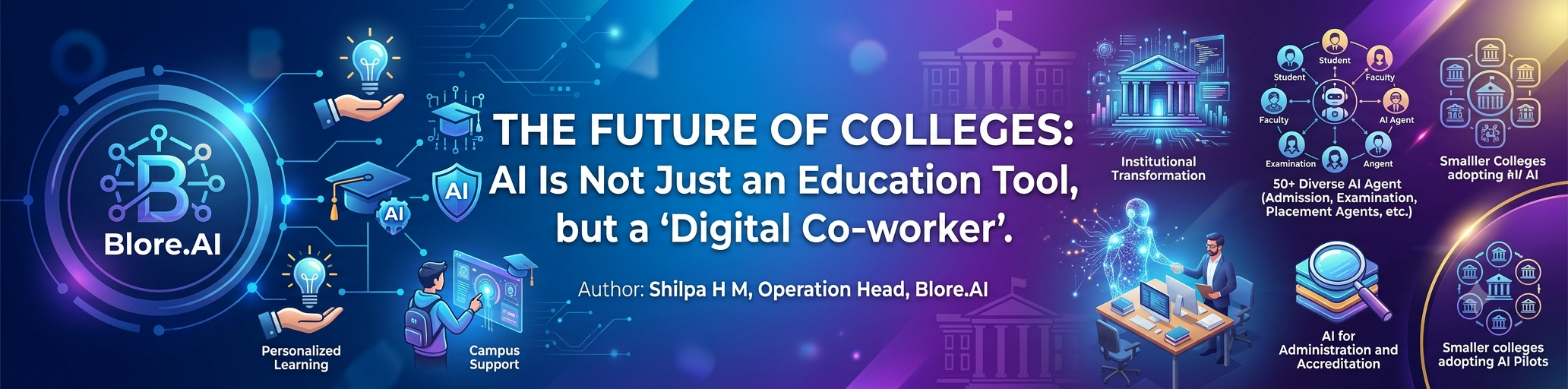
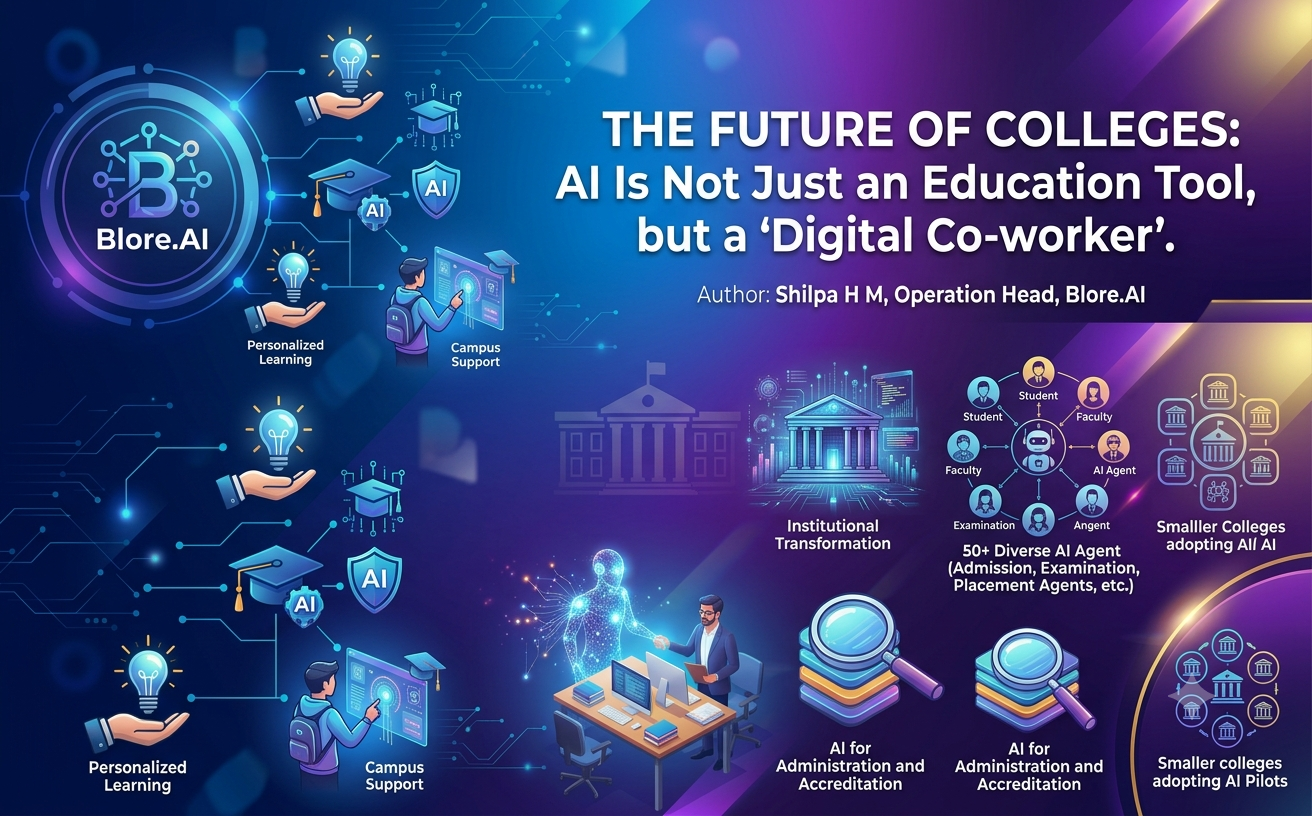
The Future of Colleges: AI Is Not Just an Education Tool, but a ‘Digital Co-worker’
The Future of Colleges: AI Is Not Just an Education Tool, but a ‘Digital Co-worker’
Artificial Intelligence (AI) is rapidly becoming part of education. Students are using tools such as ChatGPT to find answers, faculty are using AI to prepare teaching content, and educational institutions are beginning to adopt AI for different activities.
But the next stage of AI in education is much bigger.
AI will no longer remain just a tool that answers questions. It will increasingly become a digital co-worker or AI Agent that guides students, reduces faculty workload, simplifies administrative tasks, and works with different systems across the college.
Some of India’s leading educational institutions are already demonstrating what this future could look like.
Bengaluru-based REVA University, in collaboration with Salesforce, has introduced REVAion, an AI-powered digital engagement platform designed to support students across their campus journey—from admissions and enrollment to academics, campus services, placements, and alumni engagement.
For example, a student may ask:
- “How do I get my Internship Approval?”
- “What is the last date for Exam Registration?”
- “Which Placement Drives am I eligible for?”
An AI-powered system can not only provide an answer but also find the relevant information, explain the process, and guide the student on the next step.
This is different from a traditional chatbot. It represents a move towards AI that is connected to institutional services and processes.
Another important example is the Manipal Academy of Higher Education (MAHE).
Through its MAGIC (MAHE Agentic Intelligent Console) initiative, MAHE is working towards deploying AI agents across academic and administrative systems. The initiative aims to deploy 50+ AI agents over the next two years, while modernising its Student Life Cycle Management platform.
The future university may therefore not have just one AI. Instead, different AI agents could support different functions:
- Student Agent – Student support
- Faculty Agent – Teaching and faculty assistance
- Admission Agent – Admissions support
- Examination Agent – Examination processes
- Placement Agent – Career and placement support
- Research Agent – Research assistance
- Administration Agent – Administrative support
MAHE is also establishing a Salesforce Academia Centre of Excellence and initiatives such as “Agentic AI for All” to provide students and faculty with practical exposure to AI and related technologies.
This is a natural question.
The purpose of AI should not be to replace faculty, but to save their valuable time.
Faculty members spend considerable time not only teaching but also preparing lesson plans, assignments and question papers, analysing student performance, preparing reports, and maintaining academic documentation.
AI can assist with many of these repetitive tasks.
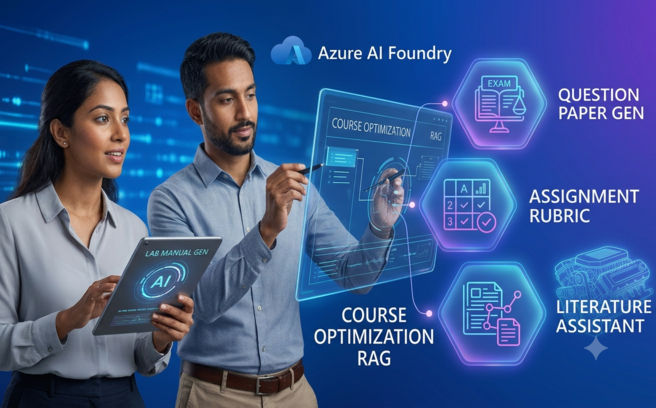
For example, when a faculty member provides a syllabus, AI can help create a draft Lesson Plan, Quiz, or Assessment Rubric. The faculty member still reviews the content and makes the final decision.
In future colleges, every student could have an AI Academic Assistant.
It could consider a student's subjects, attendance, assignments, examinations, projects, and skills to provide personalised guidance.
Skill Gap Analysis
Student: “I want to become a Java Developer. What skills am I missing?”
AI: Compares the student's current skills with industry requirements and suggests a personalised Learning Plan.
Interview Preparation
Student: “I have a Java interview tomorrow. Prepare me.”
AI: Conducts a Mock Interview, asks questions, evaluates responses, and provides feedback.
The benefits of AI go beyond the classroom.
Colleges spend significant time managing IQAC, NAAC and NBA documentation, faculty reports, placement reports, departmental records, and other institutional evidence.
An Institutional Knowledge Assistant could help answer questions such as:
- “What evidence is still pending for this NAAC criterion?”
- “Where are this year's placement documents?”
- “Which reports are still pending from the CSE department?”
Instead of manually searching through multiple files and folders, staff can ask questions and quickly find the relevant information.
The AI transformation being undertaken by institutions such as REVA and MAHE is not limited to large universities.
Small and mid-sized engineering, degree, and MCA colleges can adopt the same approach step by step.
- College Knowledge Assistant – General college information
- Faculty AI Assistant – Teaching and academic support
- Student Services Agent – Student services
- Placement + IQAC + Admission Agents – Department-specific activities
- ERP, LMS and Examination Integration – Connected institutional AI
Colleges do not need to replace their entire ERP or technology infrastructure on day one. Starting with a small pilot and expanding gradually can be a more practical and cost-effective approach.
Conclusion: Towards the ‘AI-Native’ College
The future college is not one where AI does everything. Instead, AI can take care of repetitive tasks, allowing people to focus on work that requires human judgement, interaction, mentoring, and creativity.
- Faculty can spend more time mentoring students.
- Students can receive personalised learning support.
- Placement teams can focus more on career development.
- Administrators can make better decisions using data and insights.
Today, we often talk about the “Digital College.” Over the next few years, the “AI-Native College” could become the next natural step.
Leave a comment