Inspirational journeys
Follow the stories of academics and their research expeditions
Vibe Coding: From Writing Code to Building Ideas with AI
Vibe Coding @ Blore.AI
From Writing Code to Building Ideas with AI
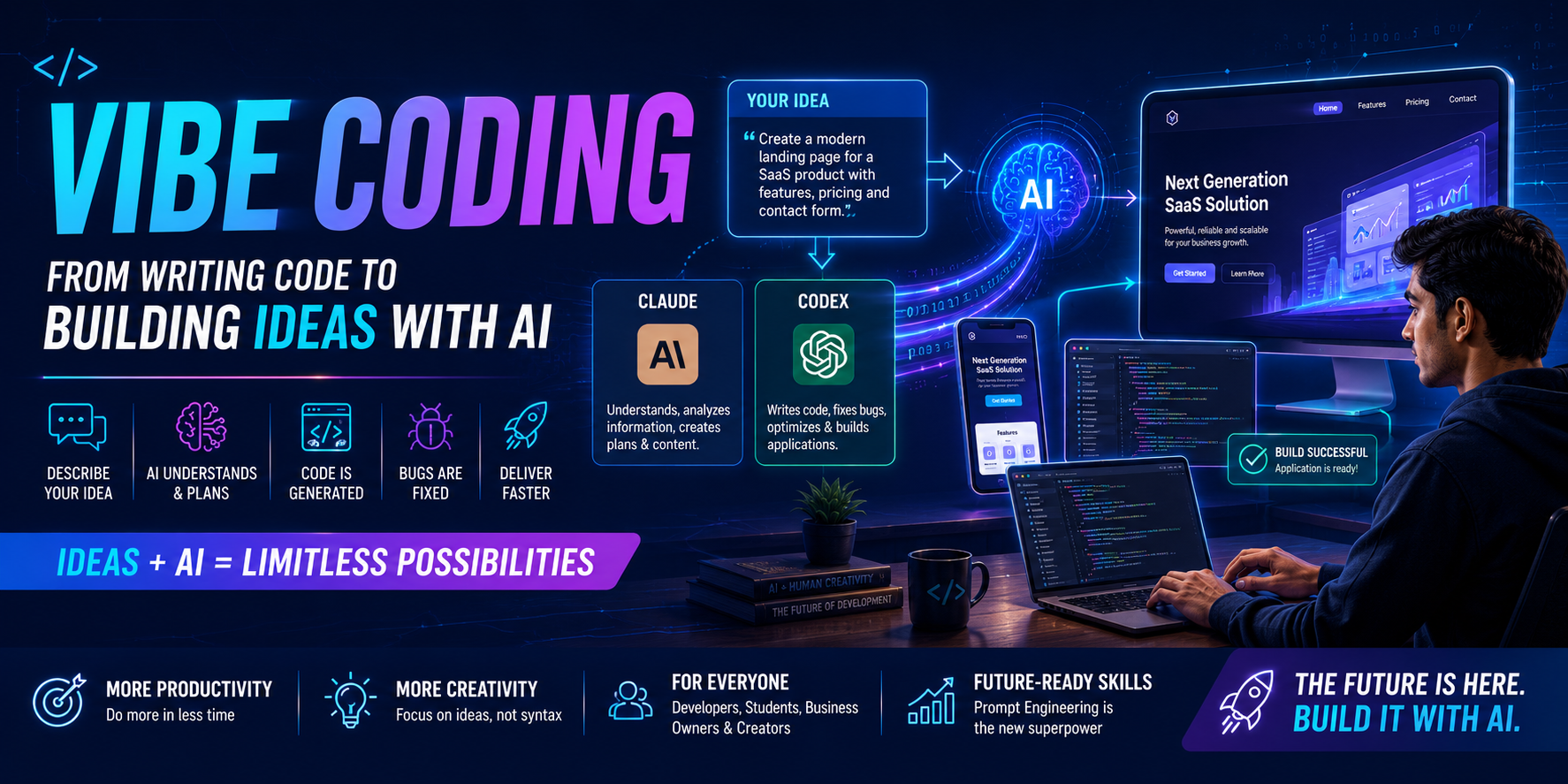
A new revolution has begun in today's digital world. Today, it is possible to build software simply by describing ideas and requirements to AI tools. This emerging approach is commonly known as Vibe Coding.
Until recently, creating a software application or website required writing hundreds or even thousands of lines of complex syntax. Vibe Coding represents a new era of productivity where human intent and ideas matter more than manual coding. The human becomes a digital director, while AI handles much of the implementation work.
What AI Can Do When You Describe Requirements Clearly:
- Generate clean, production-ready code
- Identify and fix bugs dynamically
- Suggest structural and logical improvements
- Accelerate deployment timelines and automate technical debt
Two powerful AI categories driving this transformation are LLMs optimized for reasoning (like Claude) and models specialized for application building (like Codex).
- Read and summarize massive codebases
- Assist in complex project planning
- Explain technical architectures simply
- Organize enterprise workflows
- Generate syntax from conversational text
- Identify and patch programming errors
- Build automation scripts & apps
- Accelerate software engineering tasks
One of the biggest advantages of AI-powered development is speed. Tasks that previously required hours of manual layout and debugging can often be completed in a fraction of the time, letting professionals focus on innovation, strategy, and business growth.
Vibe Coding is not limited to software engineers. Professionals across different industries can leverage modern AI tools to innovate without traditional tech backgrounds:
Create websites, build custom internal tools, and automate department workflows without large engineering teams.
Design personalized lesson plans, create interactive learning materials, and generate assessments instantly.
Prepare data reports, design compelling presentations, conduct deep research, and analyze information more efficiently.
In the AI era, success is determined not by how much code you memorize, but by how effectively you communicate with AI models. This skill is known as Prompt Engineering—the art of clearly and precisely describing structural requirements.
To succeed in the world of Vibe Coding, practical experience with AI platforms is critical. Professional training teaches participants how to use AI effectively in daily workflows, build software solutions faster, and generate clear business value.
While AI offers remarkable capabilities, it is not perfect. AI-generated outputs should always be reviewed, tested, and validated by human experts. Safety protocols must focus on:
- Accuracy and logical verification of information
- Data privacy and enterprise code security
- Ethical use of AI and rigorous human oversight
Vibe Coding represents a fundamental shift in how digital solutions are built. The future belongs to those who can combine human creativity with artificial intelligence.
The question is no longer, "Can you write code?"
The question is now, "Can you turn ideas into reality with AI?"
Leave a comment